


You’re not trying to quit forever. You’re trying to figure out what sustainable, conscious drinking looks like for you. Maybe that’s two drinks instead of five. Maybe that’s weekends only instead of every night. Maybe that’s wine but not whiskey. The Drink Tracker helps you find your personal moderation sweet spot by showing you what actually works for your body, your life, and your goals. And here’s the surprising part: just the act of tracking changes your behavior, even before you consciously try to drink less. This guide explains why tracking works and how to use it to build a moderation practice that actually sticks.
There’s actual science behind why writing things down changes behavior. It’s not magic. It’s psychology and neuroscience working in your favor.
In physics, observing a phenomenon changes the phenomenon itself. The same thing happens with behavior. When you know you’re going to track your drinking, you drink differently. Not because you’re forcing yourself to drink less, but because the act of observation creates awareness, and awareness automatically influences choice. You’re about to pour that third glass of wine, and then you remember you’ll have to log it. That tiny moment of awareness is enough to make you pause and ask, “do I actually want this, or am I just doing it out of habit?” Sometimes you’ll still pour it. But sometimes you won’t. And that choice matters.
When your actions don’t match your beliefs, your brain experiences discomfort called cognitive dissonance. If you believe “I’m a moderate drinker” but your tracker shows you’re drinking 25 drinks a week, your brain has two options: change your belief or change your behavior. Most people choose to change their behavior because it’s easier than admitting “I guess I’m not actually a moderate drinker.” The tracker creates productive dissonance that motivates change without you having to force it through willpower.
Thoughts are abstract. Numbers on a screen are concrete. When you think “I probably had three drinks last night,” it stays fuzzy and dismissible. When you see “5 drinks, $45, Thursday” written down in your tracker, it becomes undeniable. Your brain can’t minimize or rationalize away data that’s staring you in the face. The act of recording transforms vague impressions into hard facts, and facts are much harder to ignore.
Your memory is terrible at tracking patterns over time. But data doesn’t lie. After two weeks of tracking, you’ll notice “I always drink more on Tuesdays after that team meeting” or “I never exceed my limit when I eat dinner first” or “I spend twice as much when I’m at that specific bar.” These patterns were always there. You just couldn’t see them because you weren’t looking systematically. Once you see them, you can interrupt them.
Moderation isn’t one-size-fits-all. What works for your friend might not work for you. The first step is getting clear on what you’re actually trying to achieve.
What does success look like? Is it drinking less often? Drinking less per session? Spending less money? Waking up feeling good? Not doing embarrassing things you regret? Get specific. “I want to drink less” is too vague. “I want to have no more than 3 drinks per session and feel fine the next morning” is a target you can track.
Before you set limits, track what you’re currently doing for at least one week without changing anything. This is your baseline. You need to know where you actually are before you can decide where you want to go. Most people skip this step and jump straight to setting aggressive limits like “only 2 drinks per week” based on what they think they should be doing, not what’s realistic given their current patterns.
Why do you want to moderate? Health? Money? Relationships? Performance at work? Avoiding hangovers? Be honest about your motivation because it will guide your approach. If you’re moderating for health, your limits will look different than if you’re moderating to save money. Both are valid. Neither is better. But you need to know which one you’re working toward.
Look at your baseline data. If you’re currently averaging 5 drinks per session, don’t set your limit at 1. That’s a setup for failure. Try 3. If you’re drinking 6 nights a week, don’t go to 1 night. Try 4. You’re building a skill. Start with a target that stretches you slightly but doesn’t feel impossible. You can always adjust down later.
This is where most people trying moderation fail. They set a vague intention like “I’ll just have a couple” and then end up drinking way more because drunk-you doesn’t have great impulse control. Planning before you drink changes everything.
Open the app before you start drinking. Set your drink type, wine, beer, cocktails. Set your maximum number. Set your budget. You’re making these decisions when your prefrontal cortex (the rational part of your brain) is fully online. Once you start drinking, that part of your brain gets progressively quieter and your impulsive side gets louder. Lock in your limits before that happens.
One of the easiest ways to moderate is to choose one type of drink per session. Wine only. Beer only. Not wine, then shots, then beer, then cocktails. Mixing drink types makes it way harder to track how much you’ve had and dramatically increases the chances of drinking more than you planned. Pick one. Commit to it for the night.
Are you going to a wedding? A work event? A casual dinner? The context matters. Set different limits based on the situation. A Tuesday dinner at home might be a 2-drink limit. A Saturday wedding might be a 4-drink limit. Both can be moderation. The point is conscious choice, not rigid rules that don’t account for reality.
Tell someone your plan. Text a friend “heading to happy hour, planning to stick to 3 drinks.” Or just tell yourself out loud. The act of declaring your intention makes you more likely to follow through. And if you exceed it, that person (or your future self) can ask “what happened?” Not in a judgmental way, but in a curious way that helps you learn.
Planning is great. But the real transformation happens when you track during your drinking session, not the next day when your memory is fuzzy.
As soon as you finish a drink, log it. Don’t wait until the end of the night. Drunk-you will forget or undercount. Immediate logging keeps you honest and gives you real-time feedback. You can see in the moment “I’ve had 2, I planned for 3, I have 1 left.” That awareness alone often stops you from exceeding your limit.
The tracker shows you when you’re approaching your limit. That notification saying “you’re at 3 out of 3” is your decision point. Are you done for the night, or are you going past your plan? If you go past it, that’s not automatically a failure. But it’s a conscious choice now instead of something that just happens while you’re not paying attention. And conscious choices are easier to learn from.
When you’re at your limit but you want another drink, the app reminds you to drink water, do a breathing exercise, or check in with your body. These tools give you something to do in that critical moment instead of just white-knuckling it. The urge will pass, usually in 10-15 minutes. The tools help you ride it out.
The tracker prompts you to check in. How do you feel after 1 drink? After 2? After 3? Most people realize they feel best around 2 drinks and everything after that is chasing a feeling that doesn’t actually get better. That information, that you feel best at 2 and worse at 5, is incredibly valuable data for setting future limits.
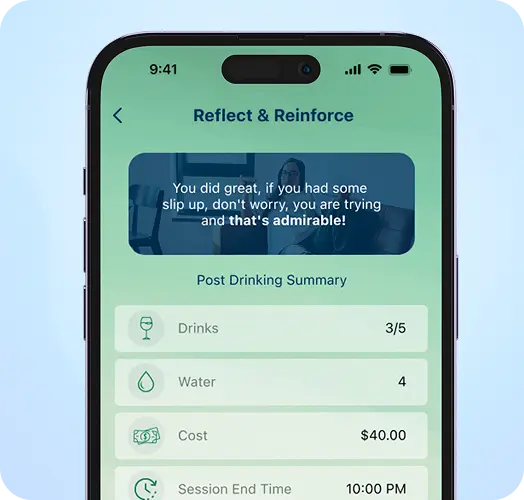
The next day (or later that night if you’re feeling ambitious), the app walks you through reflection. This is not optional. This is where behavior change actually happens.
Did you stick to your plan? If yes, what helped? If no, what got in the way? How do you feel right now? What would you do differently next time? These questions aren’t designed to make you feel bad. They’re designed to help you see patterns. Answer honestly, even when the truth is uncomfortable.
After a few weeks of tracking and reflecting, patterns emerge. “I always exceed my limit when I’m at Jake’s house.” “I stick to my plan when I eat dinner first.” “I drink more when I’m stressed about work.” These patterns are gold. Once you see them, you can plan around them. Next time you’re going to Jake’s house, set your limit higher or have an exit strategy. Next time you’re stressed about work, use a different coping tool before you start drinking.
You planned for 3 and had 3? That’s a win. Write it down. Acknowledge it. Most people only focus on the times they exceeded their limit and ignore the times they stuck to it. Celebrating the wins reinforces the behavior. Your brain learns “this feels good, let’s do this again.”
If you set your limit at 3 and consistently exceed it, don’t just keep beating yourself up. Either lower your starting point (drink less before you hit 3) or raise your limit to something more realistic (maybe 4 is your actual sustainable number right now). Moderation is a practice, not a fixed rule. You adjust as you learn what works for your body and your life.
After a month of tracking, planning, and reflecting, you’ll have enough data to identify your personal moderation patterns.
This is the number where you feel good during and the next day. For some people it’s 2. For some it’s 3. For some it’s 4 on special occasions and 2 normally. There’s no right answer. There’s just your answer based on your data. Pay attention to when you consistently feel good and when you consistently feel bad. That’s your sweet spot.
How many days per week can you drink and still feel good? Some people can drink 4 nights a week and feel fine. Some people need 5 alcohol-free days between drinking sessions. Your body will tell you if you’re paying attention. Track your energy, your sleep, your mood. If you’re drinking 5 nights a week and feeling exhausted, try 3 nights and see if you feel better.
By now you know which situations make moderation harder. Maybe it’s certain people. Certain venues. Certain emotional states. You don’t have to avoid these situations forever, but you do need a plan for them. Higher limit, buddy system, earlier exit time, whatever helps you stay within your goals when the environment is working against you.
Based on your data, what are the rules you need to follow? Maybe it’s “never drink on an empty stomach.” Maybe it’s “only drink on weekends.” Maybe it’s “no shots ever.” These aren’t arbitrary restrictions. These are boundaries based on evidence of what works and what doesn’t work for you. Write them down. Honor them.
Moderation is a skill. Skills take practice. You’re going to hit obstacles. Here’s how to navigate the most common ones.
This usually means one of two things. Either your limit is too low for your current habits (raise it to something more realistic), or you’re not planning effectively (set your limit before drinking, not during). Look at your reflection data. Is there a pattern to when you exceed it? Certain people, places, emotional states? Adjust your strategy based on the pattern.
If moderation feels like constant deprivation, you’re approaching it wrong. Moderation isn’t about restriction. It’s about conscious choice. Reframe it: you’re not “only allowed 3 drinks,” you’re “choosing 3 drinks because you want to feel good tomorrow.” The mental shift from restriction to choice changes everything. If it still feels like deprivation, your limit might be too aggressive. Adjust up slightly.
“Just have one more!” is the most common sabotage. Have your script ready. “I’m good, thanks.” “I’m sticking to my limit tonight.” “I’ve got an early morning.” You don’t owe anyone an explanation, but having a short response ready makes it easier to hold your boundary. Real friends will respect it. If they don’t, that’s information about the friendship.
This usually means you’re in situations where alcohol is the main activity. Find better situations. If the only thing to do at the party is drink, leave earlier. If your social life revolves entirely around bars, add activities that don’t center on alcohol. Moderation is easier when you’re not constantly white-knuckling your way through boring situations where drinking is the only entertainment.
You planned for 3 and had 7. It happens. That’s not a failure of moderation. That’s one data point. Look at your reflection notes. What happened? Learn from it. Adjust your strategy. One bad night doesn’t erase three good weeks. Moderation is about patterns over time, not perfection every single night.
Here’s something important: tracking might reveal that moderation isn’t actually what you want. And that’s okay.
If you’ve been tracking for a month and you’re consistently exceeding your limits, feeling bad physically and emotionally, and not enjoying the moderate amount you’re drinking, moderation might not be your path. Some people discover that the effort required to moderate is more exhausting than just not drinking at all. That’s valuable information. The tracker doesn’t judge which path you choose. It just shows you what’s real.
Some people discover that 2 drinks doesn’t feel worth it. They want 5 or they want 0. If you’re one of those people, that’s not a failure of moderation. That’s self-knowledge. The tracker helped you figure out that your relationship with alcohol is all-or-nothing, and that’s important to know. You can pivot to a different goal based on that information.
Whether you decide to moderate, quit entirely, or just keep tracking to maintain awareness, the tracker supports whatever path makes sense for you. There’s no right answer. There’s just your answer based on your data, your body, and your life.
You’re not going to figure this out in one week. You’re going to adjust, experiment, learn, and adjust again. That’s normal. That’s the process.
You’ll have weeks where you stick to your plan every time. You’ll have weeks where you don’t. Both are part of the practice. The goal isn’t perfection. The goal is progress, awareness, and making more conscious choices more often. If you’re doing that, you’re succeeding.
What feels like sustainable moderation now might change in six months. Maybe you’ll naturally want to drink less. Maybe your tolerance will change. Maybe your life circumstances will shift. Keep tracking. Keep adjusting. Moderation is flexible because life is flexible.
On the weeks when you’re slipping, the tracker shows you. On the weeks when you’re crushing it, the tracker shows you that too. It’s a mirror that reflects reality without judgment. That honest feedback is what keeps you on track over months and years, not just days and weeks.
You don’t need to have it all figured out before you start. You just need to start tracking and see what you learn.
Download the app. Track your baseline for one week without changing anything. Then set a realistic starting limit and try it for another week. Reflect on what worked and what didn’t. Adjust and try again.
Moderation is a skill. Skills improve with practice and feedback. The tracker gives you both.
Your sustainable drinking level is waiting to be discovered. All you have to do is start paying attention.
Science-backed, honest, and straight to the point